Brush & Tree Clearing: Property Value & Usability
Book now Property value land clearing Property value is not only about location. It is also about how usable, safe, and ready the land is.
When planning to build, farm, or improve a property, land clearing is usually the first major step. It is also the step that causes the most confusion when it comes to pricing.
Many property owners ask the same questions:
This 2026 Land Clearing Cost Guide explains what actually affects pricing, how contractors estimate jobs, and what property owners should understand before requesting quotes.
Land clearing is the removal of unwanted trees, brush, stumps, roots, and surface debris from a property so the land can be safely used.
Land clearing is done for many reasons, including:
Land clearing is not just cutting trees. It is a controlled process that considers soil, access, disposal, and future use of the land.
One of the biggest mistakes property owners make is expecting a standard price per acre.
Land clearing prices change based on many factors, including:
Two one-acre properties can cost very different amounts to clear.
The largest variable in land clearing pricing is how cleared material is handled.
Every tree, stump, and root has to go somewhere.
Piling and Burning
When allowed by local regulations, burning is often the most cost-effective option.
Material is stacked into piles and burned under controlled conditions.
Burning is usually cheaper because it:
Burning is not always possible.
Residential areas, burn bans, and weather conditions can prevent it.
Hauling Material Off-Site
When burning is not allowed, material must be hauled away.
This adds significant costs, including:
Root material almost always needs to be hauled off because it contains too much soil.
Hauling is one of the main reasons quotes increase.
Mulching Material in Place
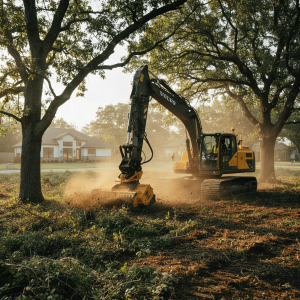
✔️Forestry mulching grinds smaller trees and brush into mulch.
✔️Mulching avoids hauling and burning but does not remove roots.
This method works best for:
Mulching is usually not ideal for full development or building sites.
The most affordable approach varies depending on the property and the specific goal, as there is no one-size-fits-all solution.
That said, common low-cost approaches include:
Manual Clearing
✔️Using chainsaws or hand tools can work for very small areas.
✔️It becomes expensive and slow on larger sites.
Brush Cutting or Mowing
✔️Good for areas with grass and small brush.
✔️It doesn’t dig up or remove roots or stumps.
Forestry Mulching
Usually, the cheapest solution for extensive areas with light to moderate vegetation.
By mulching the vegetation, you can reduce the costs of disposal, however, this method might lead to the regrowth of plants. The cheapest method is the one that matches the job.
Using the wrong method creates higher costs later.

Book now Property value land clearing Property value is not only about location. It is also about how usable, safe, and ready the land is.

Book now Technology in land clearing Land clearing methods have undergone significant changes over the past ten years. Once a strenuous, chaotic, and semi, annually
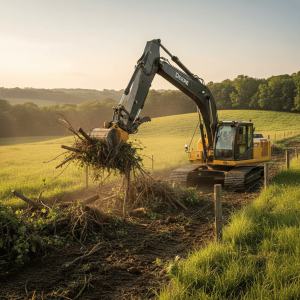
Book now Land development opportunities Land development starts with one simple question: what can this land become? Many properties look unusable at first. They can
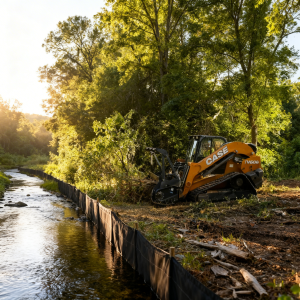
Book now Land clearing regulations Land development always starts with clearing the land. Before homes, roads, businesses, or farms can be built, vegetation and debris

Book now Future of land clearing Land clearing has always been the first step in turning raw land into usable space. Whether the goal is

Book now Building site clearing Every home starts with an idea, but it becomes real only when the land is ready. Before a foundation can

Book now Site preparation challenges Site preparation is one of the most essential parts of any land clearing project. Before a home, shop, road, or

Book now Erosion control and land clearing Land clearing is often the first step in building, farming, or improving a property. Trees, brush, and undergrowth

Book now Property maintenance underbrush Underbrush may seem like a small issue at first. It is easy to ignore a patch of vines, thick shrubs,
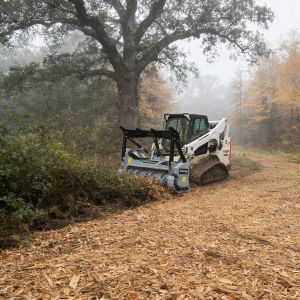
Book now Underbrush removal is one of the most important first steps in land clearing. Any piece of land if has to be used for
The following ranges are general estimates only. Actual prices vary by region and site conditions.
Estimated Cost Ranges Per Acre
These figures assume basic clearing.
Disposal, grading, or root removal may add more.
Professional contractors do not guess prices.
Quotes are based on real costs, including:
Equipment
Rental rates, delivery, and insurance all factor in.
Fuel
Labor
Transport
Disposal
Unexpected Conditions
This is why on-site evaluations matter.
Timing affects price and results.
Late Fall and Early Winter
Spring
Summer
Many contractors recommend clearing in late fall or winter when possible.
We would love to speak with you.
Feel free to reach out using the below details.
Clearing and grubbing basically entail stripping the land of trees, brush, tree stumps, roots, and other organic material debris that is laying on the surface.
Estimating generally:
A very simple estimating formula is as follows:
Estimated Cost = Base Rate Area + Density + Terrain + Disposal
Illustration:
The estimated total is most probably the base clearing, labor, fuel, and handling.
The real pricing depends on an actual inspection.
What Drives Land Clearing Costs in 2026
There is a good number of factors that influence the price this year:
Due to these factors, set prices are hardly ever feasible.
How to Reduce Land Clearing Costs
Property owners also have the ability to control the expenses by:
Land clearing is one of the most important steps in any property project.
It affects safety.
It affects cost.
It affects long-term usability.
The cheapest option is not always the best one.
Cutting corners often leads to higher expenses later.
In 2026, smart land-clearing decisions start with understanding what drives costs.
A professional land clearing contractor provides:
When land is cleared correctly, everything that follows becomes easier.